- FROM SWANSEA:
- road distance 16.74 mi, north-west
- COUNCIL:
- Carmarthenshire
- HOMES:
- general types, below
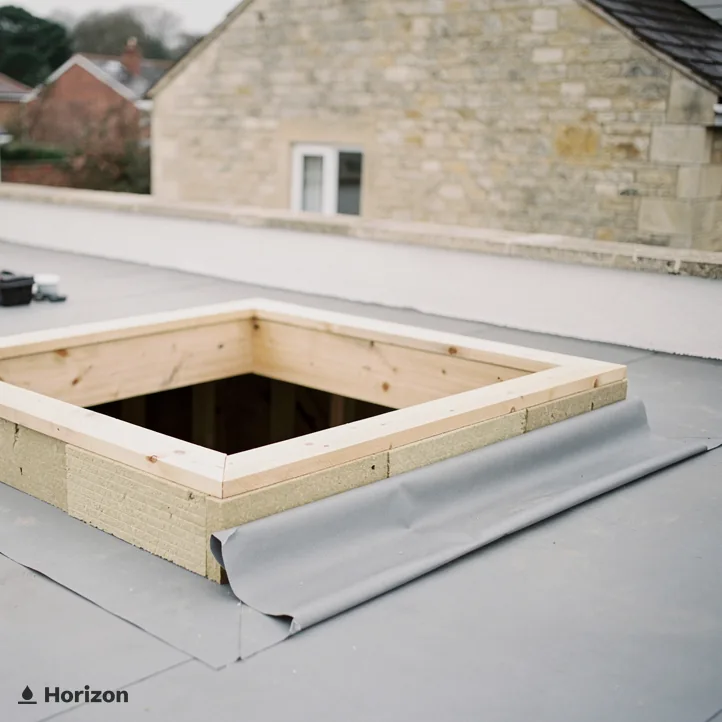
Skylight and rooflight fitting in Pontyberem
Pontyberem in the Gwendraeth Valley: a bridge, a brook and a village whose rooms need glass that copes with steam as well as rain.
Free survey / fixed written quote / Building Control notification handled / 10-year workmanship guarantee
Wet roofs and steamy rooms in Pontyberem
Weather in a valley village does its damage on both faces of the glass. Rain batters the outside. Then, once the window is shut against it, the household produces another kind of wet on the inside: showers, boiling kettles, drying laundry. A rooflight or roof window that suits Pontyberem has to cope with the two.
The outside is a matter of build. Water runs down the roof, meets the frame and has to be sent around it by the flashing and the roof covering laid against it. A tidy job there keeps water out of the lining.
The inside is a matter of air. Steam rises, and the roof is where it ends up. If the pane is cold, the steam turns to droplets and runs. Choose glass that meets Approved Document L (Wales), and the pane stays warmer. Then give the steam a way out: a window that opens, a controllable vent, an extractor that is left on after the shower is off.
Approved Document F (Wales) lays down that a replacement window should leave a home's ventilation no worse than before. A bathroom is where that duty is felt most, because it is where the air is wettest.
| Home | Roof covering | Daylight option |
|---|---|---|
| Terraced houses | pitched, slate | one roof window above the stairs or a rear bedroom |
| Detached houses with a loft room | pitched, tile | roof windows in the converted slope |
| Bathrooms under the roof | any pitched covering | an opening roof window with an extractor |
| Flat-roofed extensions | flat | a rooflight, or a lantern if the room has height |
- VALLEY:
- Gwendraeth
- POPULATION:
- 2,768 (2011)
- COLLIERY OPENED:
- 1845
A bridge, a river mouth and a brook
Carmarthenshire's Gwendraeth Valley holds Pontyberem, a village that is also a community. The name is put together from three Welsh elements, and the pieces tell you where the settlement stands: pont is a bridge, aber is the mouth of a river or the meeting of a smaller stream with a larger one, and Beran is Nant Beran, the brook that flows through the village.
Two census counts frame the recent past: 2,829 residents were recorded in 2001, and the next count, taken in 2011, found 2,768. The village grew in the late 19th and early 20th centuries as coal mining expanded around it. Four principal mines worked in the area: Pontyberem colliery, which opened in 1845; Pentremawr, from 1889 until about 1974; Glynhebog, from 1892 to 1949; and Gwendraeth colliery, known as the Watney pit. With the coal industry in the South Wales Coalfield in decline, no high quality anthracite mines operate in the Gwendraeth Valley now.
The railway ran through for a while, too. From 1909 to 1953 the village had its own station, part of the Burry Port and Gwendraeth Valley Railway, and it carried the miners as well as the residents of the locality.
The village is north-west of Swansea, 16.74 miles away by road, well within the area we cover. We fit in neighbouring Pont-henri and Tumble too.
None of that history tells us what the roofs are like. What it does say is that the village grew over several decades, and one glass will not suit houses of every age. Our survey begins with whatever roof is actually there, whichever decade built it.
The name, in pieces
- pont
- bridge
- aber
- mouth of a river; the meeting of a lesser stream with a larger one
- Beran
- Nant Beran, the brook that runs through the village
| Mine | Dates |
|---|---|
| Pontyberem colliery | opened 1845 |
| Pentremawr | 1889 to about 1974 |
| Glynhebog | 1892 to 1949 |
| Gwendraeth colliery | known as the Watney pit |
- ROOF WINDOW:
- 1.4 or Band B
- RAIN:
- flashing and lap
- STEAM:
- extractor, opening sash
The bathroom is the hard case
Few rooms put a roof window under as much strain as a bathroom does. A hot shower fills the air with water within minutes, and the glass overhead is the coldest thing it meets. If that glass is poor, you get a drip on the bath and a dark patch on the lining by spring.
Three things help, and all three are cheaper to settle before the window goes in than after. The first is the glass itself: a new or replacement roof window in Wales should reach 1.4 W/m²K or Window Energy Rating Band B, and a warmer inner pane gives the steam less to cling to. The second is the opening: a sash that tilts or pivots lets the humid air out fast, and a top-hung one can be left slightly ajar. The third is a fan, because a fan can clear a room that glass alone cannot.
The vents have numbers attached. Where the old window had none and the house depends on natural ventilation, the guidance offers a route to show the home is no worse off, and it works by area. The table gives the two sizes, and where they cannot be met the vents should come as near as practical.
Quick airing is a separate duty. Each habitable room needs purge ventilation, the guidance's name for a quick change of air, and a window that opens can deliver it. Counted by angle, a sash that opens 30° or beyond should present an opening of a twentieth of the floor area; one that opens between 15° and 30° should present a tenth; and below 15° it does not count.
Bedrooms present a quieter version of the same problem. People breathe out water overnight, and a loft room has one cold surface in the roof. Trickle vents matter there. If your old window had them, the new one should have vents no smaller, controllable by you or automatically.
For a bathroom with no outside wall at all, a window in the roof is not always the answer. A sun tunnel brings daylight down from a roof dome through a reflective tube, and the opening it needs in the roof is small. The bathroom still wants its extractor.
A flat-roofed extension has its own version of the problem. An energy-efficient rooflight or a lantern over a kitchen sees the cooking steam, and a rooflight in an existing home should reach 2.2 W/m²K. The survey checks the rated figure for the unit we propose.
The fan and the window do different jobs, and it helps to keep them apart. A fan removes damp air at its source, which is the shower or the hob. A roof window lets the whole room refresh once the steam has gone. A bathroom with both has the best chance of a clear pane afterwards.
Electric operation earns its place in a bathroom with a high roof window. A switch on the wall opens the sash from the floor, and a VELUX solar or electric model closes itself if rain starts, which matters when the window is the room's only way to air out. See electric opening rooflights for what to ask about.
Opening sash
- clears steam faster
- can be worked by hand or motor
- needs a sensible spot for the handle
Fixed pane
- lets light in and nothing more
- depends on the fan for steam
- has one less part to maintain
| Room | Equivalent area |
|---|---|
| Habitable room or kitchen | 8,000 mm² or more |
| Bathroom | 4,000 mm² or more |
- LOCAL AUTHORITY:
- Carmarthenshire
- GOWER AONB:
- not inside
- THEN:
- survey, fixed quote
Carmarthenshire and the order of approvals
For planning, a Pontyberem address answers to Carmarthenshire County Council. The Gower AONB does not include the village, so no protected-landscape rule of that kind applies. The rest of the question is covered on our page about planning permission for skylights in Wales.
A house has householder rights that a flat or maisonette lacks. A council may have removed those rights by an Article 4 direction, and a planning condition can do the same for one house. A listed building needs listed building consent for work that touches its character, a requirement now under the Historic Environment (Wales) Act 2023 and administered by the council, with Cadw as the Welsh Government's historic environment service.
If a case sits on a boundary, the council's planners can confirm where it falls, and a Lawful Development Certificate records the decision.
The Building Regulations are the other approval. They look at the structure around the opening and at the energy performance of the glass. Our part is to see the notification through on jobs that are notifiable. The body it goes to is your choice between the council's own building control and a registered building control approver.
The route is simple enough to state in a line: a free survey, a fixed written quote, then work backed by a workmanship guarantee that runs for ten years, in writing. Call 01792 929062 or ask for the survey on the enquiry form.
One point needs separate treatment. A lantern is not the same as a rooflight when it comes to the Welsh energy figure, because the 2.2 W/m²K limit is written for a glazed unit on a kerb or upstand and does not mention lanterns by name. If a lantern is planned for a new extension, we confirm how the council will treat it before the design is fixed.
From enquiry to finished glass
- Survey free, with a look at the roof from outside and the room from inside
- Quote a fixed written quote
- Paperwork notified for you on notifiable work
- Guarantee ten years on workmanship, in writing
Pontyberem, answered
Should a bathroom roof window open or stay fixed?
An opening one clears steam faster, and it can be paired with an extractor. A fixed window gives light alone, so the fan must do all the work. Which suits you comes down to the height of the glass, who will reach the handle and what the room is used for.
What does the name Pontyberem mean?
It joins pont, a bridge, with aber, a river mouth or meeting of streams, and Beran, after Nant Beran, the brook that runs through the village.
Does swapping a window change the ventilation rules?
The aim is that ventilation ends up no worse than it was. A frame that carried trickle vents should be replaced by one with vents at least as big. Where there were none, the guidance suggests minimum vent areas for a habitable room, a kitchen and a bathroom, and the survey notes what is there.
Which council deals with a rooflight at a Pontyberem house?
Carmarthenshire County Council, for planning. Its building control team can handle the Building Regulations side, or a registered building control approver can, and the two are separate approvals.
Is a sun tunnel an answer for a bathroom in the middle of the house?
It can be, when a clear line can be found between the roof dome and the ceiling. A tube carries daylight to a diffuser, and the roof opening is small. Steam still needs its own way out, so the bathroom keeps its extractor.
Where does the quote come from?
The quote comes from the survey. A look at the roof, the room below and the access gives us what we need to write a fixed written quote afterwards. Book the survey to start.
Nearby towns we also cover
Bulletin Pontyberem
Book your free survey
- Survey:
- before we price
- Quote:
- fixed, in writing
- Guarantee:
- 10 years on our workmanship, in writing
No obligation. Building Control notification handled where the work is notifiable.