- FROM SWANSEA:
- by road 15.25 mi, south-east
- COUNCIL:
- Bridgend
- HOMES:
- settled by survey
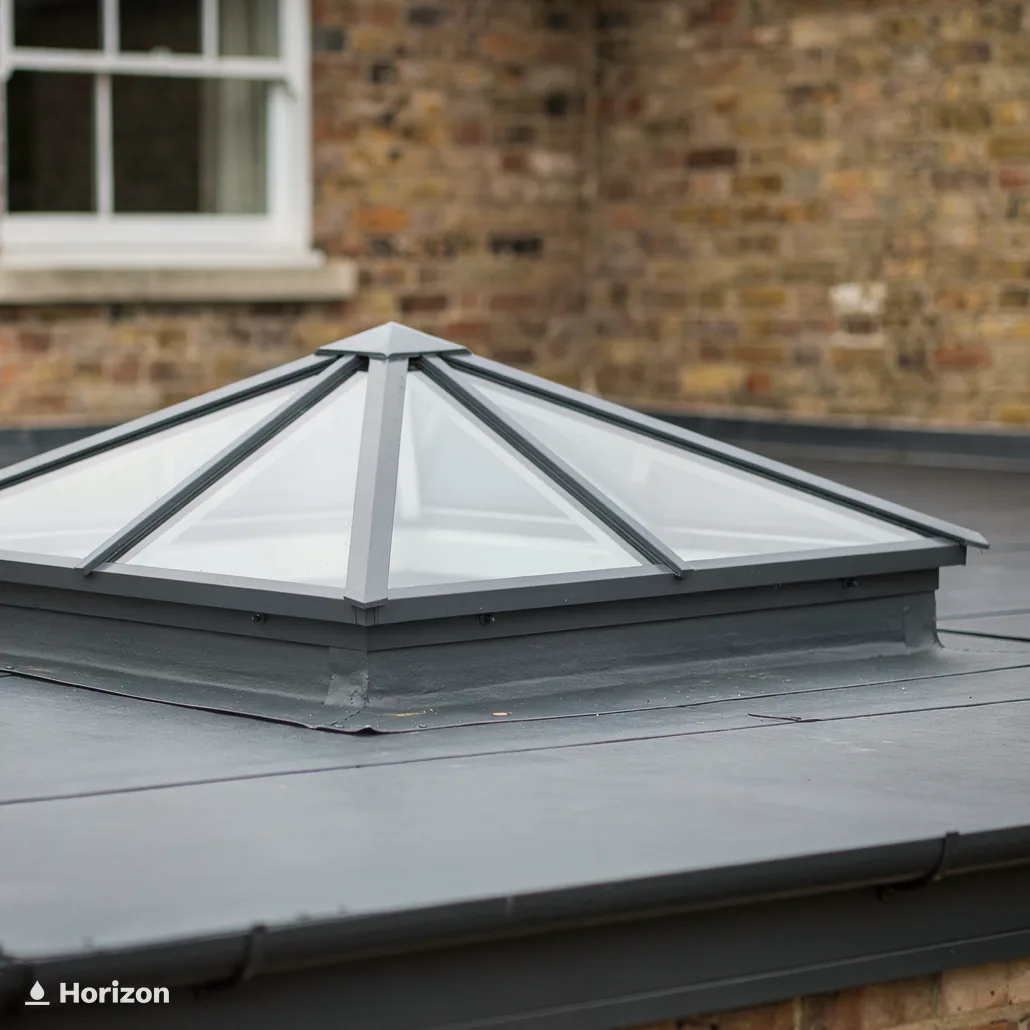
Rooflights and skylights fitted in Pyle
Pyle, Y Pîl, on the A48: lanterns and rooflights set up to shed what the weather throws at a flat roof.
Free survey / fixed written quote / Building Control notification handled / 10-year workmanship guarantee
Pitched glass over a flat extension roof
A roof lantern changes how rain behaves on a flat-roofed extension. A flat rooflight leaves water to find its own way across a nearly level pane. A lantern gives it a pitch: rain lands on sloping glass, runs down to the base and leaves over the upstand.
The upstand is where the trouble starts if it goes wrong. For its roof lanterns, Brett Martin sets a minimum height for the builder's upstand and recommends a level build. A slope of up to 5 degrees is tolerated, though the maker says the result will likely look lopsided. In practice the upstand wants to be level before the lantern is delivered.
Around the base, the flat roof still needs to drain. Water that cannot leave the roof will back up to the upstand, however well the glass sheds its own rain.
A tall lantern over a kitchen gathers the steam from the hob, and the glass sits high enough for the damp air to rise to it. A lantern with opening vents, or a kitchen with an extractor, gives that air a way out so it does not settle and run down the pane.
Noise is a lantern's other side effect. A lot of glass in one place makes a lot of rain sound, so for a room people sit in, it helps to ask about the glazing build-up early.
Elsewhere in the house the same shower falls on a back bedroom roof window. The upper edge of its flashing kit disappears beneath the covering above, and the lower edge lies over the covering below, so water can only go down and away. Pyle's name points to tidal water, and sand from the sea once buried Kenfig, but a roof window is judged by its lapping on any wet afternoon.
| Starting point | Roof | What to ask about |
|---|---|---|
| Kitchen or dining extension | flat | lantern on an upstand, or a flat rooflight |
| Back bedroom under the roof | pitched | roof window with a flashing kit |
| Hall or landing with no window | pitched, loft over | daylight tube from the roof |
| Walk-through between old and new rooms | flat or pitched | fixed rooflight over the join |
- STATUS:
- village and community
- WELSH NAME:
- Y Pîl
- M4:
- junction 37, under a mile
A village that moved inland from the sand
Y Pîl is the Welsh name of Pyle, which sits in Bridgend county borough as both a village and a community. The English name comes from the Welsh pîl, a tidal inlet, and it may refer to the mouth of the River Kenfig, which is tidal for its first mile from the sea.
The story of the place is a story of sand. The ancient borough of Kenfig was abandoned after being overwhelmed by sand in a catastrophic encroachment of the sea in the mid-fifteenth century. The road through Kenfig was diverted one and a half miles inland, which brought Pyle to prominence while Kenfig dwindled to a straggle of houses. The walls of Pyle's St James' parish church are reputed to have been moved stone by stone from the old town, which gave the church its nickname of the upside-down church: the first stones moved would have been the high ones.
The Imperial Gazetteer of 1870 described the parish, with Kenfig and Skerr, as 4,526 acres of land and 725 acres of water.
Modern Pyle works as a large village. It is served by the A48 and lies less than a mile from junction 37 of the M4, its railway station is on the Cardiff to Swansea section of the main line, and it has its own leisure centre, swimming pool, supermarket, library and petrol station. There is also a large industrial estate, which hosts some notable names and a garden centre.
Measured along the roads from Swansea, Pyle is 15.25 miles off, towards the south-east. South Cornelly, Porthcawl and Cefn Cribwr are neighbours on the map, and we fit in all three.
A weathered stone with an incised cross, dated to the eleventh or twelfth century, was moved to its present garden location in 1945, from between Kenfig and Pyle. A village that has grown beside a main road holds roofs of many ages. The survey is where we see which kind a house has.
- 4,526 acresof land in the parish in 1870
- 725 acresof water in the same count
- a mile and a halfinland, where the road was diverted
- PLANNING:
- Bridgend borough council
- AONB:
- not in Gower
- LISTED:
- consent first
Planning in Pyle, with Bridgend
A Pyle house takes its planning questions to Bridgend County Borough Council. The Gower AONB lies well away from the village, so Gower's extra rules do not come into a Pyle job.
Many house rooflights can go in without an application, if they meet a short list of conditions. The skylight planning permission guide gives that list in full. Read it with your own roof in mind, and note the cases it leaves out.
Flats and maisonettes fall among those cases, since they come with no householder permitted development rights of their own. Houses can fall there too, if the council has removed the rights by an Article 4 direction or the house's first planning permission carried a condition to the same effect. A listed house is a separate case again: listed building consent is needed for a rooflight that alters its special architectural or historic interest, and Cadw is the Welsh Government body that records listing.
The council's planning team can say where a roof stands. When you want the answer on paper, ask it about a Lawful Development Certificate. The certificate stays with the property, so a later buyer can read it too, and it costs the time of one application at the start.
Doubt is cheaper to settle before work than after it. A rooflight put in where permission was needed and not sought leaves the owner with a question that has to be answered when the house is sold, and asking first removes it.
Building Regulations are their own matter. New rooflights generally need approval because the work of forming an opening usually changes the roof's structure, and the roof then takes the weight of the glass. You can use local authority building control or a registered building control approver, and we make the Building Regulations notification where the work calls for one.
- UPSTAND:
- minimum height, built level
- ROOFLIGHT:
- 2.2 W/m²K
- ROOF WINDOW:
- 1.4 W/m²K or Band B
Lanterns, rooflights and what sits under them
A swap carries a ventilation duty. After a window is replaced, the room should ventilate at least as well as before, so trickle vents on the old frame carry across to the new one, in the same size or larger, controllable by the occupants or automatically. A loft room or a kitchen that depends on those vents is where it shows.
Choose the shape of the glass after the shape of the room. A roof lantern suits a taller space where a raised glass ceiling is wanted. A flat roof rooflight suits a lower one, and it lets light down in a plain square or rectangle.
Planning treats them differently. A lantern stands well above the roof around it, so putting one on a roof that already exists is normally a matter for a planning application. Where the lantern is designed into a brand-new extension, the position is agreed with the council at survey, because the guidance we work from leaves it open. For the rooflight on a kerb, the energy limit under Approved Document L (Wales) is 2.2 W/m²K. Roof windows in a slope have their own limit of 1.4 W/m²K or Window Energy Rating Band B.
On a pitched roof elsewhere in the house, a roof window serves a bedroom or study, and a sun tunnel serves the dark hall. Both appear in the table above, and a survey picks between them for the roof you have.
Existing glass counts as well. Glass that has fogged inside its sealed unit belongs under misted rooflight replacement, where the position has already been tried.
Dirt matters on a lantern, because pitched glass is hard to wipe once it stands high. Self-cleaning glass is available too: in Pilkington Activ, daylight works on the dirt and the next rain rinses it off, and roof glazing is one of the uses the maker lists. Raise it at survey for any glass nobody can reach.
High glass raises the question of opening. A rooflight over a kitchen is out of arm's reach, so an electric opening rooflight spares a pole and a chair. A VELUX electric model fitted with the rain sensor shuts at the first drops, so a shower in the middle of a working day does no harm to the room.
Our starting point is always the free survey, then a fixed written quote, then the written 10-year workmanship guarantee. Ring 01792 929062 to book, or use the quote form.
Getting an upstand ready
- Build it level The maker recommends level, and a small pitch can look lopsided.
- Set the height The maker sets a minimum for a roof lantern.
- Drain the roof Water that cannot leave the roof backs up to the upstand.
Roof lantern
- pitched glass on an upstand
- stands tall above a flat roof
- suits a room with height to spare
Flat roof rooflight
- glass on a kerb, close to level
- lower profile above the roof
- suits a room under a shallow ceiling
Pyle, in short answers
How tall does the upstand under a roof lantern need to be?
Brett Martin sets a minimum height for the builder's upstand under its lanterns and asks for a level build. Up to 5 degrees of slope is tolerated, but the maker expects it to look lopsided, so the survey checks the upstand first.
Will a Pyle lantern over a flat-roofed kitchen need a planning application?
Normally it does, because a lantern rises a long way above the roof beneath it. Bridgend County Borough Council gives the answer for the address, and the point goes on the survey list.
For a lantern built into a new extension, the position is confirmed with the council too.
Which side of Swansea is Pyle on?
The south-east, at 15.25 miles by road. It is within the 30 miles around Swansea that we cover.
The survey is free.
Is replacing a rooflight always building work?
Putting a new unit in place of an old one is building work, and a repair is not. Swapping just the glass inside the retained frame sits outside it for the energy rules. Where notification is needed, it is ours to make.
What is the energy limit for a new roof window in Pyle?
1.4 W/m²K, or Window Energy Rating Band B, under Approved Document L (Wales). A rooflight has a limit of 2.2 W/m²K, and the document describes it as a glazed unit on a kerb or upstand, which is why the two figures are kept apart.
When is the price fixed?
Once the free survey is done, a fixed written quote follows, and 10 years of workmanship guarantee in writing cover the finished job. To start, send the form.
Nearby towns we also cover
Bulletin Pyle
Book your free survey
- Survey:
- before we price
- Quote:
- fixed, in writing
- Guarantee:
- 10 years on our workmanship, in writing
No obligation. Building Control notification handled where the work is notifiable.