- FROM SWANSEA:
- south-east, 19.75 miles
- COUNCIL:
- the borough council
- HOMES:
- houses and flats
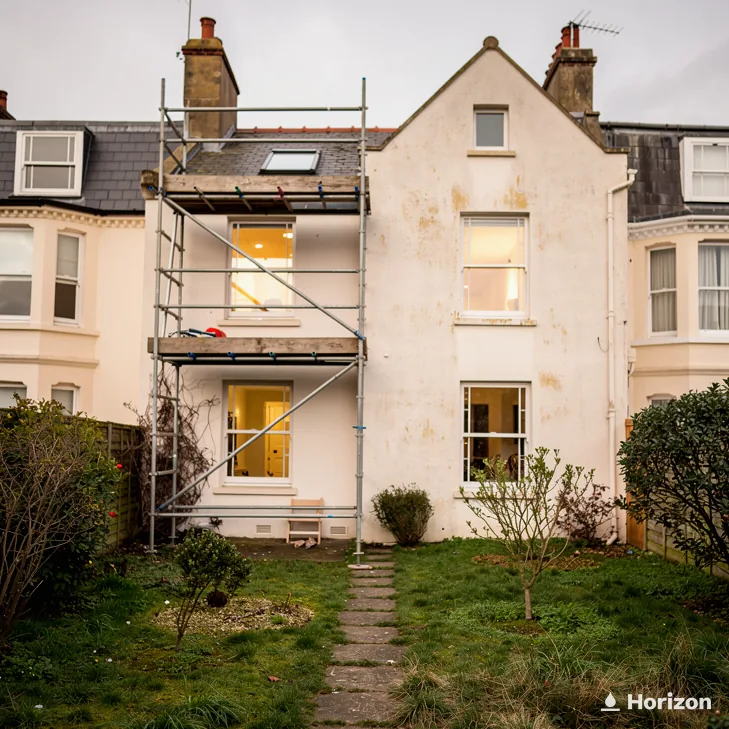
Skylight and rooflight fitting in Porthcawl
Porthcawl on its low limestone headland: open sky, a long run of sea wind, and glass that has to stay clear through all of it.
Free survey / fixed written quote / Building Control notification handled / 10-year workmanship guarantee
A headland meets the weather first
Porthcawl stands on a low limestone headland over the Bristol Channel. A coastal site like that gives rain a clear run at the roofs, and a rooflight is the part of a house that takes it face on. Whatever falls on a pitched slope or lies across a flat extension, two questions decide how the glass behaves: where does the water leave it, and where does the damp inside the room go?
A roof window sits level with the slates or tiles around it. Its flashing kit has to lap correctly with the coverings above and below, because a gust can lift water into any gap that was cut carelessly. A loft bedroom under an exposed slope is the best test of that detail.
A flat-roofed rear extension asks something else. A rooflight stands on a kerb, and the roof around it needs a fall that carries water away instead of leaving it at the frame. The installation guide from Rainclear names 5° as the least slope it advises on the kerb to stop pooling.
Indoors the trouble is condensation. Steam from a kitchen or a shower looks for the coldest surface in the room, and glazing that meets Approved Document L (Wales) makes the inner pane less likely to be that surface. An extractor that really runs does the rest of the work.
Dirt on a rooflight you cannot reach is a slow annoyance, so it pays to put the glass where a cleaning cloth or a long pole can reach it, or to ask about a coating that does the work for you. A self-cleaning coating is one answer: Pilkington Activ is sold for rooflights too, and it breaks down dirt with daylight so that a shower can rinse the pane.
| House type | Roof | Where the glass goes |
|---|---|---|
| Terraced houses | pitched, slate or clay tile | roof window over the stairs or a back bedroom |
| Semi-detached houses | pitched, tile | roof window, or a tunnel for a dark hall |
| Rear extensions | flat | flat rooflight or roof lantern |
| Flats | flat or pitched | survey and consent first |
- STATUS:
- town and community
- NAME:
- harbour, sea kale
- COUNTY:
- Bridgend
From sea kale to seaside
The name gives the first clue about the place. Porth is the Welsh for harbour, and cawl here points to sea kale, which may have grown or been gathered along this shore. Porthcawl began as a coal port in the 19th century, though its trade was soon taken by faster-growing harbours such as Barry, and the town turned to the seaside instead.
The seaside brought its own buildings. The Grand Pavilion went up in 1932 at a cost of £25,000, and it still hosts shows and the yearly pantomime. A white lighthouse built in 1860 stands at the end of the jetty. The Jennings Building, from 1832, is a grade II listed warehouse and the oldest maritime warehouse in Wales. A holiday resort that has seen its trade fall since the Valleys pits closed is also a town where people live all year, and their roofs face the same sky as the visitors' deckchairs.
The town is 19.75 road miles south-east of Swansea, and the work we take on reaches that far and further. Neighbouring villages on our list include South Cornelly and Ogmore-by-Sea.
The railway has gone from the middle of town. Porthcawl station, at the top of Station Hill, closed in 1963, and the nearest station today is Pyle. The A4229 carries road traffic to junction 37 of the M4.
Change is still under way along the front. The town's regeneration strategy envisages a new foodstore, more shops, leisure and community buildings, up to 450 houses and flats, a new promenade, a town square and parking. Whatever gets built, every new roof will want daylight from somewhere, and the older ones on the streets behind are already waiting for it.
Towns that grew in stages tend to hold several ages of house on one street, and each age has its own roof. That is why any visit starts with the roof you actually have, and why the table above is a general guide only. A single street can hold a slate terrace, a tiled semi and a flat-roofed rear extension within a few doors of each other.
Porthcawl in dates
- 1832Jennings Building
- 1860jetty lighthouse
- 1932Grand Pavilion
- 1963town station closes
- PLANNING:
- the borough council
- CONSERVATION:
- Porthcawl, Nottage
- AONB:
- outside
Consents in Porthcawl and Nottage
Applications for a Porthcawl address go to Bridgend County Borough Council, the local planning authority for the town.
Welsh Government mapping of conservation areas includes ones named Porthcawl and Nottage, and the Porthcawl line runs only a short walk from the centre. A rooflight put into the roof slope of a house inside a conservation area needs planning permission in Wales. Whether your own house sits inside a line is a matter of the exact address, and Bridgend publishes its conservation and design guidance online. The AONB map puts Porthcawl outside any designated landscape, so that route to a planning application does not apply here.
The Jennings Building is a useful reminder of another route. Altering a listed building takes listed building consent, which the local planning authority handles, with Cadw consulted. If your house is listed, ask about consent before anything is ordered.
For houses away from those protections, the conditions are laid out in the Wales planning guide for skylights and rooflights, which is worth reading before a design is settled. Where the work is notifiable, we handle the Building Control notification ourselves.
When a plan leans on a rule's limit, put the question to the planning officers at Bridgend. A Lawful Development Certificate turns their view into a written answer before work begins, and it gives a buyer something to read if the house changes hands later.
Two further situations take away the usual freedoms. An Article 4 direction lets a council withdraw permitted development rights from houses in an area, and conditions attached when a house was first built can have the same effect. On a newer estate house, ask whether such a condition was written in years ago.
The two consents ask different things of the same job. Planning looks at how a change affects the look of the house and the area around it. Building control looks at how the work is put together: the opening in the roof, the strength of the structure around it, and the energy performance of the glass.
- EXTENSION:
- kerb rooflight or lantern
- LOFT:
- roof window in the slope
- HALLWAY:
- dome and tube
Roofs under the headland wind
A rear extension is where most rooflight thinking starts. A glass roof lantern over a flat roof sheds rain down its pitched panes onto the upstand, and a flat rooflight leans on a kerb and a fall in the roof to do the same job. A lantern usually stands far enough above the roof that putting one onto an existing flat roof normally needs a planning application. Where the lantern belongs to a new extension, the council gives us the answer at survey. Read more on roof lanterns and flat roof rooflights.
A flat rooflight is a different glass product from a lantern, and in Wales a new or replacement rooflight in an existing home should reach 2.2 W/m²K. A roof window has its own limit of 1.4 W/m²K or a Window Energy Rating of Band B.
Upstairs, a roof window brings a loft bedroom up to a proper height of light. On a gusty night an open sash invites rain, so some owners choose electric units. Manufacturers such as VELUX fit an integrated rain sensor to their solar and electric roof windows, and it shuts the window when rain starts. Details are on our electric opening rooflights page.
Interior hallways and landings go dim all day, whatever the weather outside is doing, because no outside wall is there to carry a window. A sun tunnel collects light in a low dome above the slates or tiles and hands it down a silvered pipe to a diffuser at ceiling height. Rain slides straight off a dome that size, and the tube passes through the roof space without taking a room's worth of floor.
A bathroom with a roof window overhead is the room where steam and glass meet most directly. The extractor needs to run for long enough to clear the air, and glazing options matter too. Among the VELUX glazing choices are a laminated inner pane, which holds the glass together if it breaks, and a rain noise reduction option. Which of these a given window offers depends on the window and its glazing variant.
Flats are the odd case. A top-floor flat in a seafront block may share its roof with the whole building, and the householder freedoms that apply to houses do not extend to flats or maisonettes.
Asked in Porthcawl
Does a rooflight in the Porthcawl conservation area need planning permission?
In Wales it does. A rooflight added to the roof slope of a house inside a conservation area needs planning permission from Bridgend County Borough Council. The mapped boundary was drawn for the area as a whole, which makes your exact address the deciding fact.
Who checks the building work on a rooflight in Porthcawl?
Local authority building control at Bridgend, or a registered building control approver if you prefer one. The two bodies cover the same ground, and you are free to choose. We take the notification on for work that needs one.
Is Porthcawl inside the area you work in?
Well inside it. Porthcawl is south-east of Swansea by 19.75 road miles, which leaves ten to spare on a 30-mile radius. The A4229 joins the town to junction 37 of the M4.
Could an old VELUX roof window in a Porthcawl loft be matched for size?
A metal type sign sits along the top of the sash and shows when the window is open. The size code printed on it records the window's width and height, and VELUX has put one on each window built after 1968. A replacement roof window should reach 1.4 W/m²K or Window Energy Rating Band B.
Will the glass in a Porthcawl bathroom roof window mist up?
Steam condenses wherever the room is coldest, so a bathroom puts glass under real strain. Glazing that meets the Welsh limit of 1.4 W/m²K keeps the inner pane warmer than a poor window would, and an extractor fan that runs on after the shower has finished clears what is left in the air.
How do I get a price for a Porthcawl rooflight?
Begin with the free survey, since no one can price the job from a photograph. The fixed written quote follows the visit, and a 10-year workmanship guarantee in writing goes with the finished job. To book a visit, send the enquiry form.
Nearby towns we also cover
Bulletin Porthcawl
Book your free survey
- Survey:
- before we price
- Quote:
- fixed, in writing
- Guarantee:
- 10 years on our workmanship, in writing
No obligation. Building Control notification handled where the work is notifiable.