- FROM SWANSEA:
- 23.53 mi, north-west by road
- COUNCIL:
- Carmarthenshire
- HOMES:
- general types only
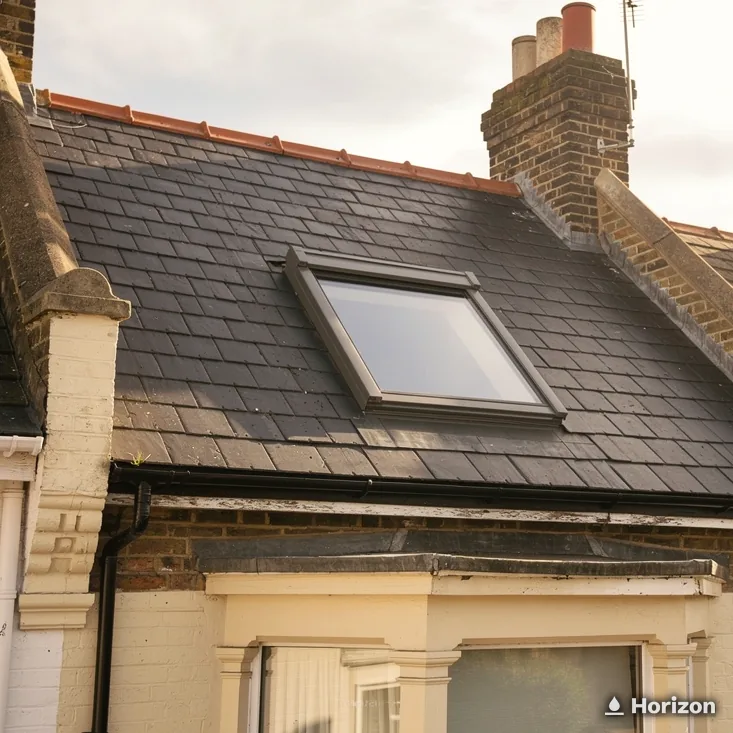
Skylights and rooflights in Ferryside
Ferryside, or Glan y Fferi, on the shore of the Tywi estuary: open water on one side, and roofs that have to cope with whatever crosses it.
Free survey / fixed written quote / Building Control notification handled / 10-year workmanship guarantee
A shoreline roof in a squall
A village on an estuary watches its weather arrive. Ferryside faces the River Tywi, and open water gives wind and rain a long, clear run before they meet the first roof. A rooflight there has little time to settle before the next squall, so it helps to know what each part of it is for.
The first part is the edge. On a pitched roof, the flashing around a roof window has to be woven into the slates or tiles with care, so that wind-driven rain finds nothing but overlaps. The second part is the surface. On a flat roof, a rooflight needs a fall behind its kerb. Manufacturers typically ask for one, and Rainclear's installation guide gives a minimum of 5 degrees on the kerb to limit pooling.
The third part comes afterwards, indoors. The weather that drives rain against the roof also keeps people inside, cooking and drying washing, and all that moisture heads for the coldest surface. A warmer inner pane takes some of the strain, and a room with a way for air to move takes the rest.
Noise is the fourth. VELUX lists a rain noise reduction variant among the glazing for its roof windows, and it is a choice to make when ordering. Cleanliness is the fifth. Where glass is too high for a cloth, self-cleaning glass earns a mention, and roof glazing is among the applications Pilkington gives for its Activ range.
| House type | Roof | Daylight option |
|---|---|---|
| Older cottages and villas | pitched | roof window sized to the slope |
| Mid-century and later houses | pitched, tile | pair of roof windows, or a light tube |
| Rear and side extensions | flat | kerb rooflight or roof lantern, with a fall |
- RESIDENTS:
- 846 (2011)
- RAIL LINK:
- South Wales Railway, 1852
- FERRY:
- relaunched 2018
A ferry landing that the railway grew
Ferryside is a village, and the 2011 census counted 846 residents. Its Welsh name is Glan y Fferi. It began as a landing-place on the ferry route to Llansteffan, a crossing that Giraldus Cambrensis used in 1188, and it developed as a fishing village. In 1844 the parish population stood at 895.
Much of the village grew after 1852, when Isambard Kingdom Brunel's South Wales Railway linked it to Carmarthen and Swansea. Today the station offers regular connections to London Paddington, Pembroke Dock, Milford Haven, Carmarthen, Swansea and Cardiff, and in 2017 it received a government grant to buy new equipment.
Water still shapes daily life. The ferry across the Tywi to Llansteffan ended in the 1950s, and a new service began in 2018, run by Carmarthen Bay Ferries with a customised Sealegs amphibious craft. It offers crossings of five to ten minutes to Llansteffan, plus estuary trips of 45 minutes and sunset trips of an hour, helped by a £300,000 grant from the Coastal Communities Fund. The River Towy Yacht Club is based in the village, and the parish church, St Ishmael's, stands on a rock near the shore.
Swansea sits at the start of our distances, and Ferryside lies about 23 road miles from it, in the north-west, well inside the 30 we cover. Among the closest places on our list are Kidwelly and Trimsaran.
Housing is the gap in our sources. They tell us the village grew with the railway, and nothing about how its houses were built, so the table beside the radar lists house types in general. A survey of your own roof turns that into advice for one house.
It is worth separating the roofs that came with the railway's growth from later additions, because each calls for a different approach. An older pitched roof may take a single roof window in the rear slope. A later extension will probably have a flat roof, where the fall and the kerb matter most. Which of those you have depends on your house, not on the village.
Dates on the Ferryside timeline
- 1188ferry used by Giraldus Cambrensis
- 1852South Wales Railway arrives
- 2018new ferry service begins
- PLANNING:
- Carmarthenshire County Council
- GOWER AONB:
- outside
- ENERGY:
- 1.4 roof window, 2.2 rooflight
Carmarthenshire County Council and the paperwork
Planning applications for Ferryside go to Carmarthenshire County Council. Our guide to skylight planning permission in Wales explains whether a given rooflight needs one, and Ferryside is outside the Gower AONB, so that designation adds nothing.
The council also runs building control, and Wales lets you pick a registered building control approver instead. Both apply the same regulations, but they are separate from planning and neither overrules it. Any window, roof window or rooflight is building work to fit. For a brand new rooflight the usual outcome is that approval is needed, since the roof has to be opened up and then has to carry the glass. If the work is notifiable, we send the notification to the body you chose.
For energy, the guidance is Approved Document L (Wales). A new or replacement roof window should reach 1.4 W/m²K, or Window Energy Rating Band B, and a rooflight on a kerb or upstand 2.2 W/m²K. A rooflight's figure takes in the whole of the unit's developed surface, which is often larger than the hole in the roof. If the kerb arrives with the rooflight as one assembly, the same 2.2 limit takes in the kerb.
Some houses start from a different position. Flats and maisonettes carry no householder permitted development rights, and a council may take those rights away from houses with an Article 4 direction. A listed building needs consent from the local planning authority, with Cadw consulted. Starting before consent arrives can lead to prosecution.
Part of the same regulations deals with air. A home should be no worse ventilated after a window is replaced than before it, and the guidance suggests that vents in the new frame should be no smaller than any in the old one. An opening roof window can also serve as purge ventilation, though only if it opens far enough in relation to the size of the room.
If you want a formal view of your own house, ask the council what it thinks. A Lawful Development Certificate puts the view in writing.
The roof windows page explains how a roof window can serve as an escape route from an upper room.
| Question | Answered by |
|---|---|
| Is the alteration acceptable? | local planning authority |
| Does the work meet the regulations? | council building control or registered approver |
| Is the house listed? | listed building consent route, Cadw consulted |
- FLAT ROOF:
- needs a fall
- GLAZING:
- double or triple
- AGEING UNIT:
- swap if misted
Flat roofs, wide glass and wet weather
Extensions to older houses so often have flat roofs that the question of falls comes up early. Glass laid over a flat roof sheds rain only as well as the roof beneath allows. A kerb-mounted flat rooflight with a proper slope behind it sends water away, while one sitting in a hollow holds it. A roof lantern hands the water down its glazed pitches instead.
Which of the two suits depends on the room. Brett Martin recommends building a lantern's upstand level, adding that up to 5 degrees of pitch is possible but will probably look lopsided. If a lantern is proposed for a new extension, we ask the council how the rules apply before going further.
The glass is a second choice. On the VELUX flat and curved glass rooflights, buyers can choose double or triple glazing, which the maker pitches at energy efficiency and sound reduction. For the choices in full, see energy-efficient rooflights.
Pitched roofs take roof windows. On a shallow slope VELUX makes a low-pitch window for 10 to 20 degrees. A stairwell or hall without an outside wall can take a sun tunnel instead.
Out of reach is where an opener earns its keep. The electric and solar roof windows from VELUX have a rain sensor built in, so the sash shuts without being asked, a help when the weather turns and nobody is home to notice. The electric opening rooflights page has the detail.
A unit with fog between its panes has lost its seal, and misted rooflights can be replaced like for like, with the new unit expected to meet the Welsh limit.
Ring 01792 929062 or use the form to arrange a survey. It comes before any price, the quote is fixed and written, and once the job is done you hold a 10-year workmanship guarantee, also in writing.
Kerb rooflight
- flat glass on a raised kerb
- needs a fall so rain runs off
- double or triple glazing offered
Roof lantern
- pitched glass on an upstand
- level upstand recommended
- up to 5 degrees of pitch is possible
Asked in Ferryside
Which council decides a Ferryside planning application?
For planning, the answer is Carmarthenshire County Council. For Building Regulations you may use its building control service or a registered building control approver, and the two decisions are separate.
What is Ferryside called in Welsh?
Glan y Fferi. That is the spelling we use alongside the English name, wherever a Welsh form is called for. The village itself began as a landing-place on the ferry route to Llansteffan.
Do glass rooflights come in triple glazing?
Both double and triple glazing are listed by VELUX for its flat and curved glass rooflights, in the interests of energy efficiency and sound reduction. Which one suits a given room is a matter for the survey, and the energy figure for the finished unit should meet the Welsh limit of 2.2 W/m²K for a rooflight on a kerb or upstand.
Would a lantern suit a flat-roofed extension?
It can. Brett Martin recommends a level upstand and allows up to 5 degrees of pitch, though it warns of a lopsided look. The survey shows whether the roof underneath suits one, and whether the extension's structure can carry it.
How many road miles is Ferryside from Swansea?
About 23, heading north-west. That is inside the 30-mile radius we cover, which stretches across Carmarthenshire, Neath Port Talbot and Bridgend, so Ferryside is among the places we can reach comfortably for a survey.
What comes first when I get in touch?
A free survey, then a fixed written quote. Ask for the survey through the form and nothing is priced until it has happened. Afterwards, the guarantee on our workmanship comes in writing and lasts 10 years.
Nearby towns we also cover
Bulletin Ferryside
Book your free survey
- Survey:
- before we price
- Quote:
- fixed, in writing
- Guarantee:
- 10 years on our workmanship, in writing
No obligation. Building Control notification handled where the work is notifiable.