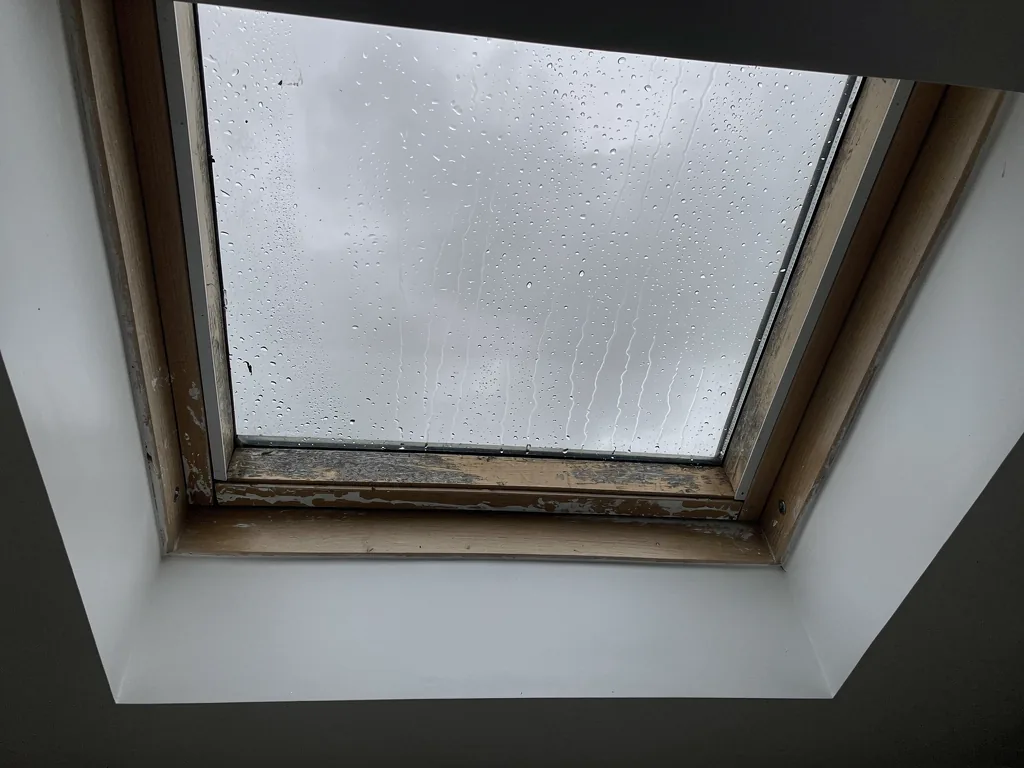
Two sheets of glass with a sealed gap between them stay clear for as long as the gap stays shut. When a damp haze shows up inside that gap, the seal has gone, and no amount of cleaning will bring the sky back.
The cause of a failed seal cannot be read from the floor, and the answer stays the same: new glass. What takes some care is telling mist from steam and from dirt, then deciding whether the glass unit or the whole rooflight has to go. The free survey comes first, on the roof itself, and the fixed written quote follows it.
What sits between the panes
A double-glazed rooflight is two panes held apart by a gap that is closed at the edges. Triple glazing adds a third pane and a second gap. In one VELUX specification, 16 mm of argon sits between laminated glass indoors and toughened glass outdoors. Whatever fills it, the gap is meant to be shut to the room and to the weather.
When moisture shows inside, the closure has failed. Air from outside has found its way into a space built to keep it out, and the water in that air has settled on the cold glass as droplets, a bloom or a grey film. The whole assembly is called a sealed unit, and that unit is where the fault lies.
From below it can look like a smear on the inside of the window. Look longer, and the haze is held between two panes, with a clear face on either side of it.
Inside the sealed gap
- Stays put whichever face you wipe
- Shows as a haze, a bloom or beads of water
- Means the seal has let go
On a face of the glass
- Clears under a cloth or as the room settles
- Steam on the room side, dirt on the outside
- Points to the room or to the weather
Why a cloth cannot reach it
Wiping works on a surface. The haze in a failed unit lives in a gap that has no door, so there is no face to wipe and no way to dry the space from outside. The same closure that kept the gap clear for years now holds moisture in.
The test takes a dry cloth, a bright hour and a minute at the window. Start with the room face. Then look at the outer face from the garden, a landing window or the next roof. Anything that clears was a surface matter. Whatever stays is inside the unit, and wiping both faces a second time will not move it.
Cleaning products do not help, and neither does leaving a window open to air the room. Both deal with the faces. The moisture is in the gap between them.
A dry-cloth check
- Room face Wipe it. If the haze clears, it was steam, and the room is the thing to look at.
- Outer face Look from outside. A dull, even film that cleaning removes is dirt and dried rain.
- The gap Anything left, between the two panes, is the sealed unit.
What a rooflight seal has to live with
A wall window looks sideways at the weather. A rooflight looks up. Rain lands on it directly, the sun reaches it for a good part of the day, and on a clear night it faces the cold sky. The seal along the edge of the unit lives with every one of those.
Any of them might play a part in a seal letting go, and so might a frame that has been knocked or has moved. Which one it was is not something a unit gives away. What the survey can do is read the condition of the frame and the roof round it, and that tells us what the new glass is going into.
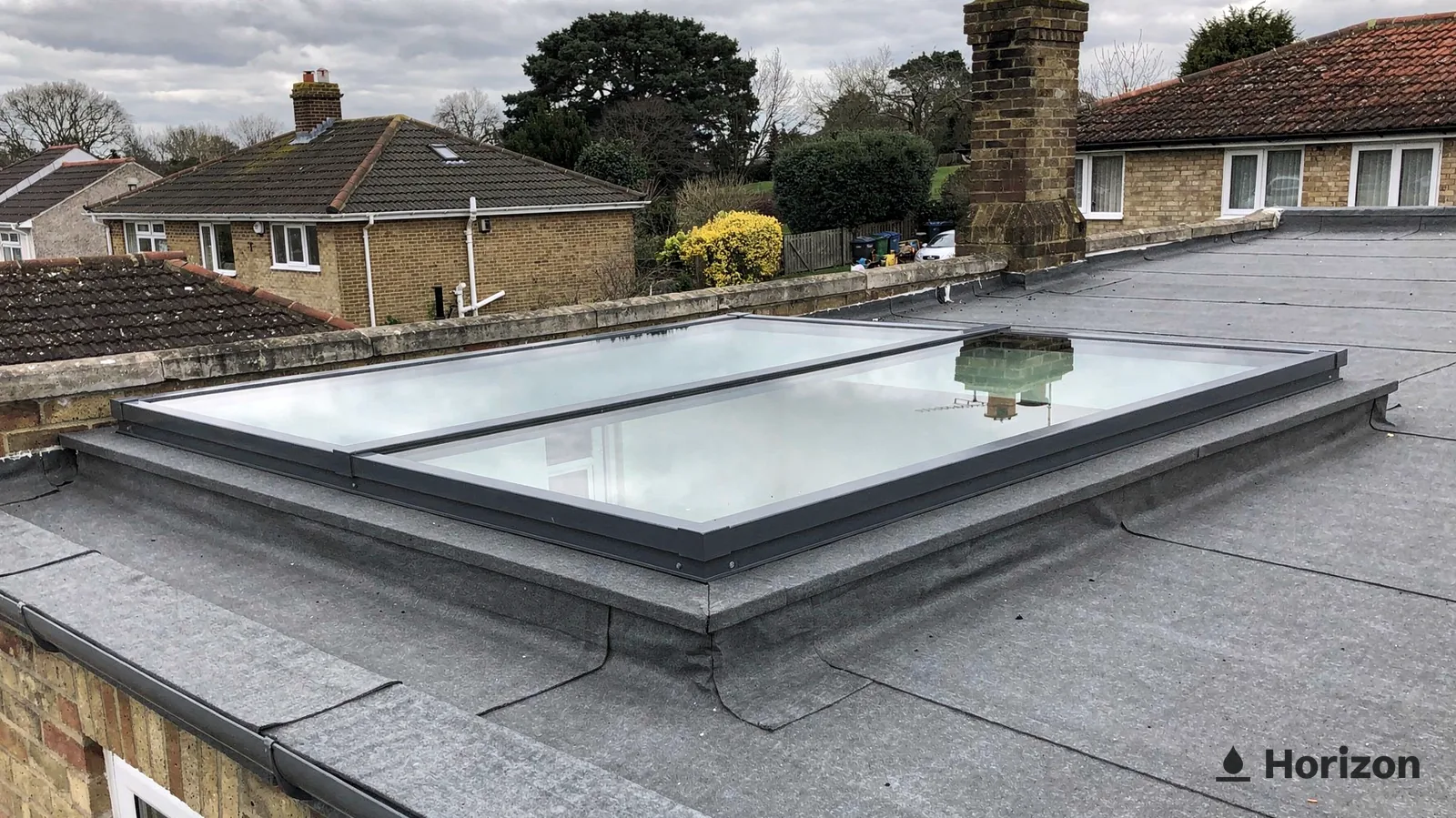
A rooflight on a flat roof meets standing water along its kerb. One on a pitched roof meets wind-driven rain along its flashing. Both sit in the same sky. That is a reason to look at the roof as well as the glass, since a new sealed unit inherits whatever the old one was sitting in.
A rooflight takes its weather from above, and the seal at the edge of the glass takes it with the frame.
Mist, steam and a leak are three faults
Steam on a bathroom roof window after a shower is any cool surface meeting warm, wet air. The moisture lands on the room face and fades as the room settles. A kitchen rooflight over the hob does the same. That is a ventilation matter, handled by an extractor that runs or a window that opens, and a new sealed unit will not change it.
A leak is different again. Rain has got past the weathering round the glass, and it shows indoors as damp patches on the ceiling, on the lining or beside the frame. A flat-roof rooflight over a utility room can show both faults in one week. Mist is the glass and a leak is the roof, so the survey looks at both. The separate answer on a misted rooflight, problem or just ugly carries that further.
What the survey reads on the roof
Once the glass is known to have failed, the question moves to everything round it. The frame comes first: does it sit square, does a sash that opens close with an even gap, and are the corners tight? Next the kerb or upstand, and the way the roof covering is dressed up to it. Last the flashing, on a pitched roof, where the covering laps over the edge of the window.
Where all of that is sound, the sealed unit can be swapped and the rest left in place. Where the frame has moved or the weathering has gone, the better route is a whole new rooflight. Which of the two your roof calls for is laid out in the step-by-step comparison of swapping the glass and swapping the whole rooflight.
Lanterns over extensions
Where a roof lantern is glazed with sealed units, it can mist the same way. Whether one panel can be lifted out with the frame staying put turns on the lantern in question, and the upstand under it gets measured as well.
| Look at | Sound | Points to a whole new unit |
|---|---|---|
| Frame | Square, tight corners | Twisted, gaps at the joints |
| Sash | Closes with an even gap | Sticks or sits crooked |
| Kerb or flashing | Dry, firm and square | Standing water or loose covering |
Reading the old unit before you ring
A replacement has to be made to the size of what is there. If the window is a VELUX, open the sash on a dry day and look along its top edge for a metal plate, the type sign. VELUX says every window made after 1968 has one. The code on it gives width and height, and in VELUX's table MK04 comes out at 78 × 98 cm. A photo of the plate is a useful thing to send with your message. Our guide to VELUX size codes goes further.
The sign is a VELUX feature, so another maker's unit, or one made to measure, has no such code. In that case the opening gets measured directly, and a flat rooflight is read from its kerb.
It also helps to know which room sits under the glass, whether the haze is in one pane or across the whole unit, and whether the window opens by hand or by motor.
The Welsh rules for putting it right
Building work in Wales is judged against Welsh Approved Documents. The energy rules draw a line between the two routes. New glass in the frame already there is left out of building work, while a whole roof window or rooflight coming in counts, new or as a like-for-like swap. Approved Document L (Wales) says a new or replacement roof window should reach 1.4 W/m²K, or Window Energy Rating Band B, and a rooflight 2.2 W/m²K. Our guide to Part L in Wales explains them. Roof lanterns get no mention in the document, so the figure for one is confirmed with the council.
Where the work is notifiable, we handle the Building Regulations notification with local authority building control or a registered building control approver.
If the swap becomes a new opening
A bigger hole, or a rooflight in a roof that has none, is a new rooflight. In a conservation area, inside the Gower AONB, in Bannau Brycheiniog National Park or in a World Heritage Site, a new rooflight in a roof slope needs planning permission. The planning guide for Wales covers the rest, including flats and maisonettes, which have no householder permitted development rights.
Booking the survey
Ring 01792 929062, send a message on WhatsApp or use the quote form. The visit is free and comes first. At it, the glass, the frame, the roof round it and the room below are all taken in, and a fixed written quote follows.
What shifts the figure is set out in the cost of swapping a misted unit, and how long sealed units last covers what the new glass can be expected to do. Our workmanship is guaranteed for a decade, in a document you keep, described on our guarantee page.
The patch we work is the city of Swansea and about 30 road miles round it, taking in parts of Neath Port Talbot, Carmarthenshire and Bridgend. The areas page lists the towns.
A haze inside the glass is the unit asking to be replaced. The frame decides how much goes with it.