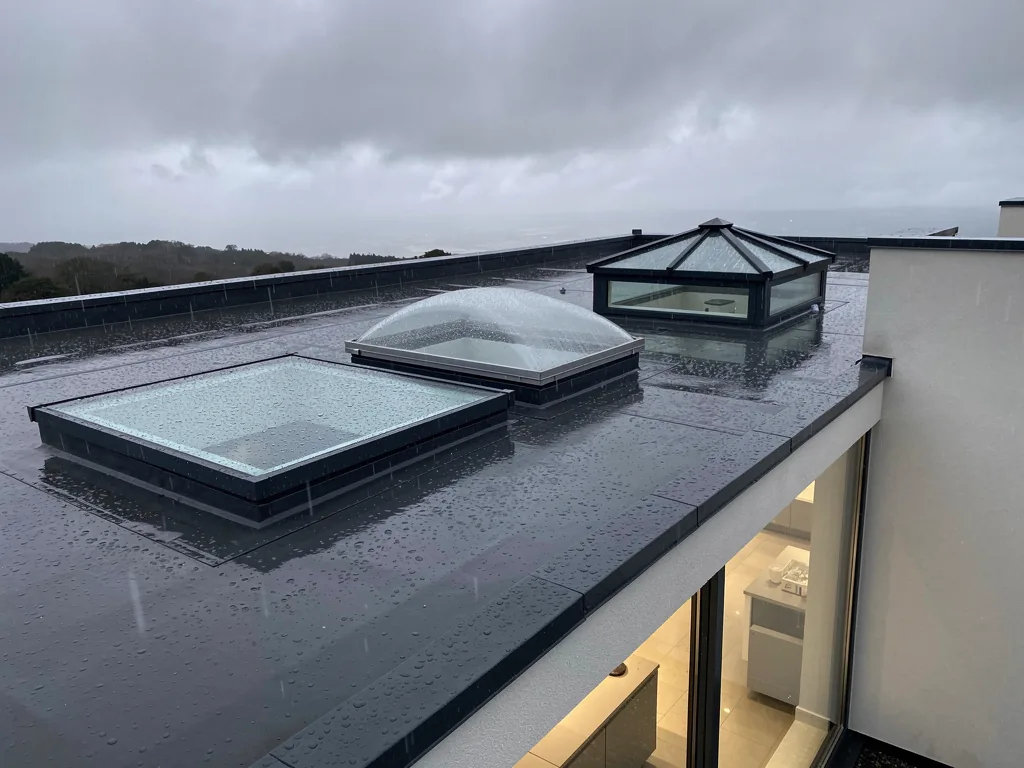
A flat roof is rarely flat. It has a fall, a covering and an outlet, and whichever rooflight goes into it has to work with all three before it does anything for the light.
Four questions settle the choice: what the room is for, how the roof drains, whether the unit should open, and what the glass is made of. Planning and the Building Regulations sit behind all four, so the answer has to be one the council and building control can accept as well.
The right choice depends on a roof we have not yet seen, so we settle it at a free survey, ahead of a fixed written quote.
Start with what the room is for
A rooflight over a bathroom has a different job from one over a hallway. In the bathroom it meets steam every morning. In a hall or landing with no outside wall, it may be the only daylight the space gets, so glass area matters more than anything that opens.
Living and dining rooms ask for a third thing: comfort at the table. Light that lands on the place where people sit is worth more than a large unit that floods the far wall, and the glass specification is worth discussing for that spot. A utility room or boot room, where the glass collects splashes and muddy air, leans towards a unit that is simple to wipe.
The table below puts those jobs beside the choice each one points to. It is a starting point for the survey conversation, and the roof then confirms or overrules it.
| Room below | What the unit copes with | Choice to weigh |
|---|---|---|
| Bathroom or shower room | steam on the inner pane | an opening unit, or an extractor |
| Hall or landing with no outside wall | daylight is the whole point | fixed glass can be enough |
| Dining or living space | warmth and glare at the table | glass specification and size |
| Utility or boot room | splashes and grubby glass | a coated pane that wipes clean |
What the roof allows
Pick the roof first and the unit second. A flat roof drains by a fall towards an outlet or a gutter, and the rooflight has to sit on that fall without making a dam of it. Rainclear, a rooflight maker, recommends a kerb sloped at 5° or more, which keeps water from pooling against the frame. For its dome, VELUX specifies roofs from level up to 15° of pitch, which shows how little slope these products expect.
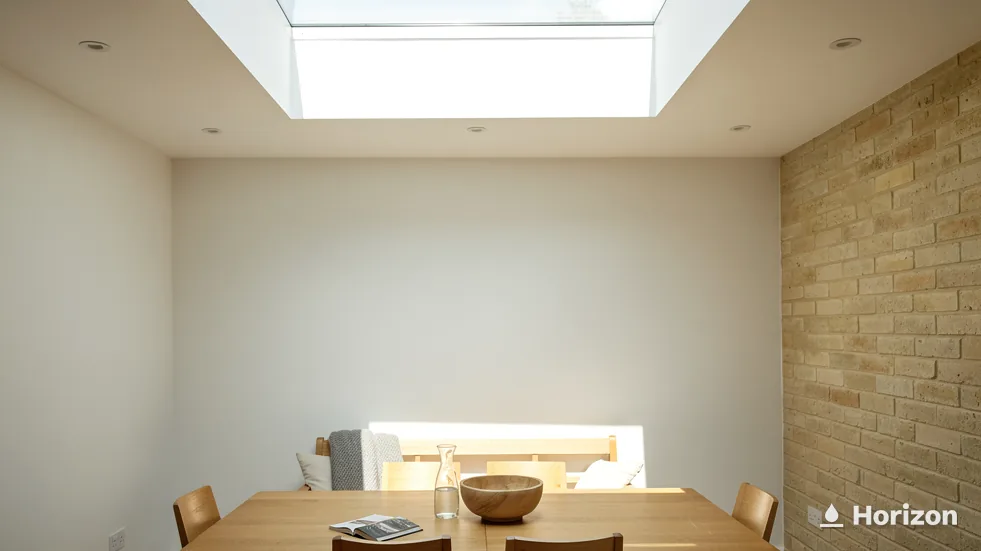
Cutting the opening is structural work. Building Regulations approval is generally needed for a new rooflight, says the Welsh Government, and its list of reasons includes the roof structure usually having to be altered to make the opening. The framing around the opening is part of what we look at in the survey.
Replacing a rooflight already in the roof
A replacement starts from an opening that exists. A straight swap for the same kind of unit is building work, and a patch-up is not. When the glazing alone changes and the existing frame is kept, the energy rules exclude it. When a tired unit needs glass alone and when it needs the lot is covered in our guide on sealed unit or whole rooflight.
The covering matters as well. The kerb and the roofing have to be dressed together so water cannot find its way behind either. On a replacement job we look at the existing kerb and the roof covering at the survey, because a sound kerb may carry a new unit where a tired one cannot.
Choose the roof's fall first and the rooflight second.
Fixed glass or an opening unit
A fixed rooflight brings in daylight and a view of the sky. An opening one adds a way to let steam and stale air leave, either with a handle you can reach or with a motor. Where the ceiling is high or the roof is out of reach, an electric unit saves climbing for a pole.
Rain is the usual worry with an opening unit on a flat roof, and it is a fair one. On the solar and electric models of its roof windows, VELUX includes a sensor that closes the window when rain arrives. Our pages on how rooflight rain sensors work and on electric or manual opening go through what that means for a flat roof job.
A bathroom or a kitchen gets the most from opening glass. A hall that only needs daylight can be served by a fixed unit with nothing to wear out.
Fixed unit
- daylight and sky overhead
- air has to leave by another route
- no sash or motor to look after
Opening unit
- daylight and a way to clear steam
- manual handle or electric motor
- an electric version needs a power supply
Glass: layers, coatings and a roof you can reach
Two panes or three are offered on VELUX flat and curved glass rooflights, with energy and sound performance given as the reasons. Extra layers are a trade-off, and the survey weighs them against the room and the roof. For the energy side, Approved Document L (Wales) says a new or replacement rooflight in an existing home should have a U-value no worse than 2.2 W/m²K. Approved Document L (Wales) bases a rooflight's U-value on the whole developed surface of the unit, which is often bigger than the hole in the roof.
Cleaning is the other glass question. A flat roof is easy to see from above and hard to reach, so a coating that keeps the outer face clear earns its place. Pilkington lists roof glazing as one place its Activ coating can go. The coating loosens dirt with daylight, and rainfall carries it away. Among VELUX glazing options is a dirt-repellent finish that makes the glass easier to wipe, although availability changes from one window and glazing variant to the next.
Breakage matters over a room people use. A laminated inner pane is on the VELUX option list, there so that a breakage does not send glass into the room. Ask for it by name when you talk through the specification.
Flat glass, dome or lantern
Three shapes are on offer for a flat roof. Flat glass sits level on its kerb and keeps a low profile. A dome curves up from the kerb, and VELUX offers its flat roof dome for pitches of 0 to 15°. A lantern is a pitched glass roof in its own right, built on an upstand.
The lantern is the one that changes the paperwork. Brett Martin specifies a builder's upstand of at least 150 mm for its lanterns and suggests building it level, and a unit on an upstand like that usually stands well over 15 cm proud of the roof. On an existing flat roof, that normally falls outside permitted development and needs planning permission. Where an extension is yet to be built, the council is asked about a lantern in it before anything is specified. The detail is in our guide to roof lantern planning permission in Wales, and our roof lanterns page covers the product itself.
Flat glass and domes are rooflights as Approved Document L defines them: a glazed unit installed out of plane with the roof surface, on a kerb or upstand.
A walk-on rooflight is a separate product with its own questions about loads and grip, covered under walk-on rooflights. If the plan is a roof terrace, remember that a rooflight resulting in a roof terrace needs planning permission.
| Shape | Roof it suits | Weigh up |
|---|---|---|
| Flat glass | flat roof with a fall to an outlet | kerb height and the 2.2 W/m²K figure |
| Dome | pitch from 0 to 15°, per VELUX | how the curve looks from the garden |
| Lantern | a roof with room for a builder's upstand | a planning application, normally |
The rules for your address, then the order of decisions
Whichever unit wins, the address decides the permissions. In Wales, adding a rooflight to a house in a conservation area, in Bannau Brycheiniog National Park, inside the Gower AONB or in a World Heritage Site is not permitted development, so it needs a planning application. Elsewhere, a rooflight on a house may stand no more than 150 mm beyond the plane of the original roof slope, and no higher than the highest part of the original roof; the full conditions, including the side-slope rule, are in our skylight planning guide. The companion guide on planning and building control for flat rooflights takes both sets of rules in turn.
A listed house can add a further step: where the work affects its character, listed building consent is needed, applied for through the local planning authority and outside permitted development.
For what moves the price once the choice is made, read how much a flat roof skylight costs, and for a roof with no rooflight yet, can you put a skylight in an existing flat roof.
Where the work is notifiable, we handle the Building Regulations notification with local authority building control or a registered building control approver.
With the permissions understood, the choice runs in a fixed order.
Deciding in order
- Name the room's job Steam, daylight for a hall, comfort at a table or a wipe-clean utility room.
- Read the roof's fall Find the outlet and note where water lies after rain.
- Fix or open Open where steam or stale air gathers; fix where daylight is the only aim.
- Specify the glass Layers, coating and a laminated inner pane if the room is a busy one.
- Check the address Conservation area, Gower AONB, National Park, World Heritage Site or listed house.