- FROM SWANSEA:
- road distance 28.12 miles
- COUNCIL:
- Rhondda Cynon Taf
- HOMES:
- roofs of every shape
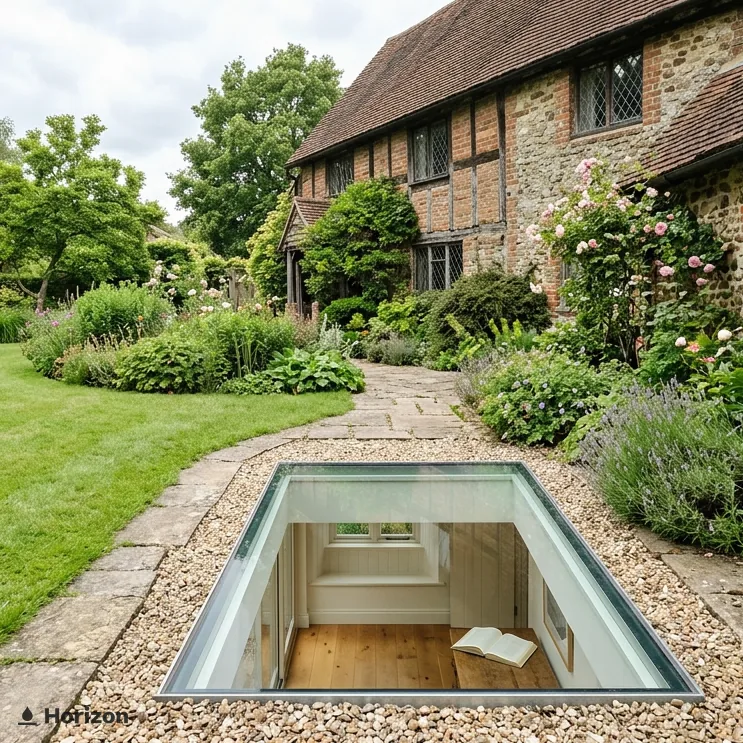
Skylight and rooflight fitting in Gelli, Rhondda Cynon Taf
Gelli, a former coal mining village in the Rhondda: a place with Bronze Age finds beneath it and a plain case for more daylight above.
Free survey / fixed written quote / Building Control notification handled / 10-year workmanship guarantee
Wet days in Gelli, from the slope to the sitting room
A wet day follows a roof from top to bottom. The rain lands on the covering, runs along it, meets whatever interrupts it, and carries on down. A rooflight is an interruption, so the work on a pitched slope is to make the interruption gentle: the flashing kit acts as a short channel round the frame, tucked in beneath the courses higher up and lapped over the courses lower down, so the stream passes the glass and rejoins the slope.
Steam is the second half of the day. A shower fills a small room with warm water vapour, and the glass above is the coldest surface in reach. Fit a window that opens, run a fan, and the vapour has somewhere to go before it turns to droplets.
Noise is the third. Rain landing on glass reads louder in the room beneath than rain on a tiled slope. One glazing option on the VELUX list is aimed at exactly that, and a bedroom with a light sleeper is where it earns a mention.
Dirt gathers on glass nobody can reach, and VELUX also lists an easy-to-clean coating. Availability varies from one window model to the next, so the choice waits until the roof has been seen.
| Roof shape | Where it shows up | Likely glass |
|---|---|---|
| Pitched slope | main roof of a house | a roof window set in the slope |
| Flat roof | kitchen, garage or porch addition | a rooflight on a kerb |
| Lean-to | back-of-house extension | a shallow-pitch roof window or a rooflight, as the angle allows |
| Pitched roof above a windowless hall | centre of the house | a sun tunnel with a ceiling diffuser |
- STATUS:
- village in Ystrad
- PAST:
- coal mining
- FINDS:
- Bronze Age, Romano-British
Hen Dre'r Gelli and the Bronze Age under the village
Gelli is a former coal mining village and a district of the community of Ystrad, in the Rhondda. It has an unusual claim for a valley village, because archaeology there has turned up evidence of earlier populations, mostly from the Bronze Age. Gelli also holds one of only two definite Romano-British finds in the Rhondda Valleys.
The best-known site is the settlement at Hen Dre'r Gelli, excavated in 1903. Roman finds in the uplands of Glamorgan are scarce, and this is the only undefended settlement of its type in the Rhondda. A lengthy report appeared in 1906. Little of the site survives today, since much of it was destroyed when the Nant y Gwyddon refuse tip was built.
The drive from Swansea comes to 28.12 miles, heading east, so Gelli lies inside our 30-mile working radius. We also survey in Hendreforgan and Gilfach Goch.
Nant-y-moel and Ogmore Vale are among the nearest villages to Gelli, and we survey roofs in both. A visit to one is easy to combine with a visit to the other when the dates suit.
Gelli belongs to the community of Ystrad. The council deals with both under the same planning authority, and the survey needs only the house itself.
The mining past says nothing about a particular roof, which has to be read in person. A pitched slope takes a roof window. A flat roof takes a rooflight raised on a kerb. A hall with no wall to the outside takes a sun tunnel. Those three cover the glass choices at a Gelli house, whichever year the house was built.
- PLANNING:
- Rhondda Cynon Taf
- BUILDING WORK:
- notified to building control
- LISTED HOMES:
- consent first
Rhondda Cynon Taf County Borough Council and the roof
Gelli answers to Rhondda Cynon Taf County Borough Council for planning. Three separate questions may come up for a rooflight there: planning, Building Regulations and, for a listed building, listed building consent.
Planning comes first for a house; the council reads the roof against the rules, and its planning team answers questions about a particular house. On a house outside a conservation area, National Park, AONB or World Heritage Site, some rooflights can go in with no application where they respect the limits on projection, height and side-facing slopes, and the Wales planning guide carries the exact conditions. A flat or maisonette is outside those householder rights. So is a house where an Article 4 direction or a planning condition has taken them away.
Building Regulations check the construction. Cutting a new opening will generally call for approval, because the structure around it has to hold the unit. Replacing an existing window or roof window is building work as well. Repair does not count, and for the energy rules neither does renewing only the glass. Where the work is notifiable, we put the notification through the council's building control or a registered building control approver, whichever you prefer.
Building control looks beyond the glass. It checks the framing round a new opening, the weight the roof has to carry, the fire performance of the unit where it stands near a boundary, and the energy figures. Where a house already has an automatic sprinkler system, Welsh guidance says the system should be extended and re-certified to cover the altered area, a point that surprises people who expect it to stop at the old walls.
A listed building is a separate matter. If a rooflight would change the character of the building, listed building consent is required under the Historic Environment (Wales) Act 2023. The application is made to the council as planning authority. The consent applies to features inside as well as outside.
When it is hard to tell which of these applies, the council's planning team will say how it reads the case. A Lawful Development Certificate then puts the position on paper.
Planning
- asks how the roof will look
- decided by Rhondda Cynon Taf
- householder rights may apply to a house
Building Regulations
- ask how the opening is built
- council building control or a registered approver
- cover structure, energy and ventilation
- SLOPE:
- window in the slope
- FLAT:
- kerb rooflight
- DARK HALL:
- ceiling diffuser
Putting daylight where the roof allows it
Pick the roof first and the glass follows. A top-hung roof window hinges at the head and swings up, which leaves headroom at the opening. A centre-pivot window turns about its middle, bringing the outer face inside for cleaning. The roof window is the product for a pitched slope, flashed into the covering. Approved Document L (Wales) says a new or replacement one should reach 1.4 W/m²K, or Window Energy Rating Band B. The wording is guidance and the figure is the target.
Over a flat roof, a flat roof rooflight stands on a kerb and should reach 2.2 W/m²K. Taller glass in the shape of a lantern is a different case, and on a new extension the council gets a question first.
Where a room has no outside wall and nothing above it but roof space, a sun tunnel passes daylight down a tube to a ceiling diffuser. It suits halls, landings and bathrooms with no window.
A pane gone cloudy between its layers wants fresh sealed glass or a fresh rooflight, and our page on misted rooflights deals with it. Where a roof window is to be fitted for escape from a loft room, the size and position are set by the escape rules, which our roof window regulations page covers.
Size and area need watching. For a rooflight the U-value covers every part of the unit's developed surface, which may exceed the opening in the roof, and a kerb delivered with the glass sits inside the 2.2 limit. Where a new opening is cut or an old one enlarged, the windows and doors together should also stay within a set share of the home's floor area, and from 4 March 2027 the new Welsh edition counts roof windows and rooflights in that total.
Fresh air matters as much as light. A hinged or pivoting window that opens 30 degrees or more can give purge ventilation as long as its opening area is at least 1/20 of the floor area, and one that opens only 15 to 30 degrees needs 1/10. Under 15 degrees it does not count.
Approved Document N's requirement on the safe opening and closing of windows and skylights does not apply to dwellings. Glass in a low position falls under its impact rules instead: the lowest part of a wall or partition counts as a critical location, and glass there should break safely, withstand impact, come in small panes or be protected for good. Approved Document N fixes the height of that zone.
Fixing the date a house was built does not decide which of these applies. The roof's pitch, the room beneath and the route to the sky are the facts the survey records, and the fixed written quote follows from them.
The first step is a free survey, and the next is a fixed written quote. A ten-year workmanship guarantee in writing goes with the finished job. To book, call 01792 929062 or use the form.
From enquiry to a finished roof
- Ask Tell us the room and the roof.
- Survey Free, before any price.
- Quote Fixed and written.
- Guarantee Ten years of workmanship, in writing.
Gelli questions answered
Which council decides on a rooflight at a Gelli house?
Rhondda Cynon Taf County Borough Council is the planning authority. For the Building Regulations you can pick its building control service or a registered building control approver. The two are separate decisions, one about how the roof will look and one about how the work is built, and both can apply to the same job.
Where does Gelli sit in relation to Swansea?
By road it is 28.12 miles to the east. The distance sits within our 30-mile limit by road, which makes a free survey in the village an ordinary booking, followed by a fixed written quote.
What does the village's archaeology have to do with a rooflight?
Nothing in the roof itself. The finds at Hen Dre'r Gelli, excavated in 1903 and written up in a lengthy report in 1906, are part of the local record, and a rooflight at a house is judged on the house, its position and its roof, whatever lies in the ground nearby. Our planning guide sets out the questions to ask, and the council's planning team answers the doubtful ones.
When does a replacement count as building work?
Taking out a roof window and putting in a new one of the same kind counts as building work, so the energy figures apply to the new unit. Repair does not, and for the energy rules neither does a change of glass inside a frame you keep.
Which glass figure should a new roof window meet?
1.4 W/m²K or Window Energy Rating Band B. A rooflight on a kerb should reach 2.2 W/m²K. Both come from Approved Document L (Wales), which is guidance, so the figures read as what the glass should reach.
How do I start?
Send the form or ring 01792 929062. A free survey comes before any price, and a fixed written quote comes after it. The finished work carries a ten-year workmanship guarantee in writing. Naming the room and the roof shape above it gets the first conversation off to a quick start.
Nearby towns we also cover
Bulletin Gelli, Rhondda Cynon Taf
Book your free survey
- Survey:
- before we price
- Quote:
- fixed, in writing
- Guarantee:
- 10 years on our workmanship, in writing
No obligation. Building Control notification handled where the work is notifiable.