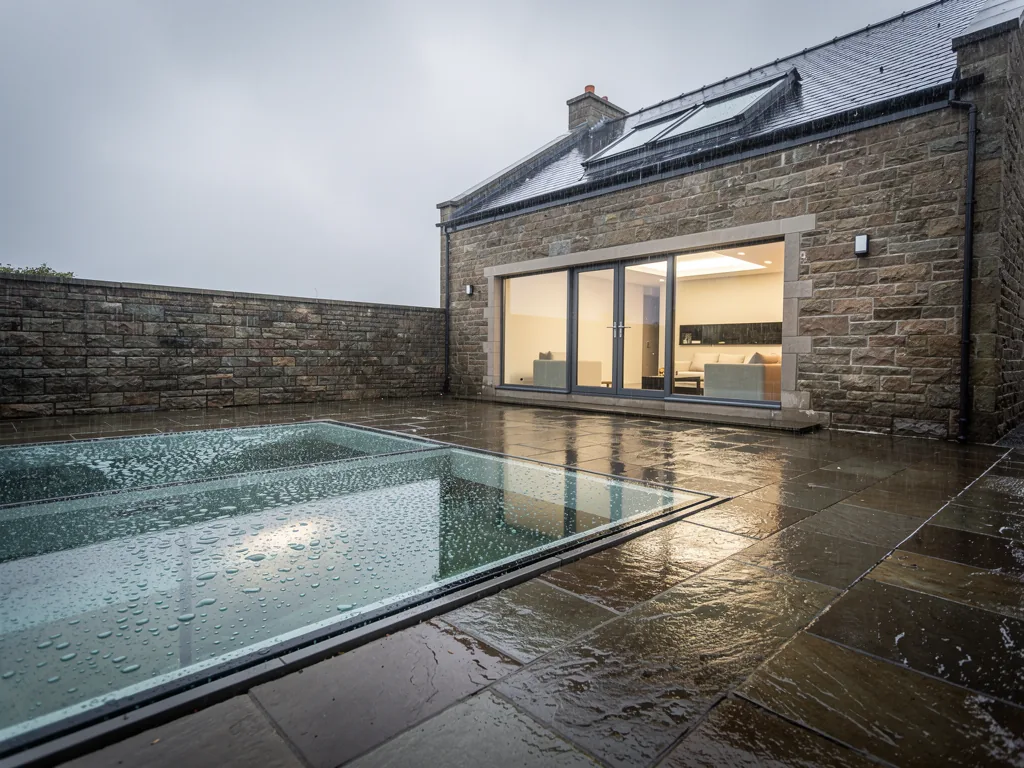
A load rating is a number with a promise attached. The number says how much weight, the promise says in what circumstances, and the circumstances are where a terrace and a brochure part company. A rating earned by one person standing on a fully supported pane says little about a table, four chairs and a planter that rain has just filled.
Choosing walk-on glass starts with a list of what will stand on it. Next comes the maker's wording, and after that the roof underneath. We go through the list at the free survey, and the fixed written quote follows it.
What a rating is a promise about
The rating belongs to the maker. It states what the maker says the unit is made to carry, under the maker's name, so the first job is to settle exactly what the words cover. A rating can describe people walking across the glass, a group standing together, or heavier things set down on it. Those are different loads, and one rating does not stand in for another.
Two details sit behind any figure. The first is how the load arrives. A person's weight spreads over a wide patch of glass, while the foot of a chair or the corner of a planter pushes down through a far smaller one. The second is how the edges are held. A pane supported on every side behaves differently from one resting on two, and the rating belongs to the unit supported the way the maker describes. Support it another way and you are no longer holding the maker's rating, so ask what supports the unit needs.
Get the rating in writing, with the use it covers named beside it. A figure with no use attached cannot be compared with the next supplier's figure.
Terms on a datasheet
- Dead load
- The weight of the glass and frame themselves.
- Imposed load
- The weight that people and things put on the glass.
- Point load
- Weight pushed through a small area, such as a chair leg or a planter foot.
- Spread load
- Weight shared across a wider area, such as a person standing.
- Support
- The frame, kerb or structure that holds the edges of the glass.
Who and what will stand on the glass
Start at the terrace, the lightwell or the path, and list everything that will sit or stand on the glass through a year. Be generous with the list. The glass is chosen for its heaviest ordinary use, and that use is easy to forget when the list is made on a sunny afternoon.
The uses differ more than people expect. A path from the back door to a garden shed, laid across a flat roof, takes walkers and a wheelbarrow of compost. A cover over a basement stairwell may carry nobody except the person who climbs out to clear a gutter. A terrace above a kitchen carries a table, chairs, a barbecue and a row of pots. Each of those puts a different kind of weight on the pane.
Furniture moves
A chair is a point load at the best of times, and a chair pushed back from the table is a point load that travels. When the furniture will live on or beside the glass, tell the supplier the full story: which pieces, and how heavy they are when full or loaded.
People belong on the list as well as things. A glass panel in the garden draws a crowd on a summer evening, so picture the busiest day you can and put that day on paper for the supplier.
Write the list down and keep it with the datasheet. When a supplier replies with a rating, hold the two side by side and see whether every line on your list is covered.
| Use | What presses on the glass | Question for the maker |
|---|---|---|
| Path across a flat roof | walkers, a loaded wheelbarrow | Is the rating for moving loads? |
| Cover over a lightwell | someone stepping across to reach a gutter | Does it cover standing in one spot? |
| Terrace above a room | table, chairs, barbecue, pots | Does it cover furniture on the glass? |
The route the weight takes to the roof
Glass is the part you see and the smallest part of the story. Weight on the pane travels down through the frame, the kerb or upstand, and the roof structure beneath, in that order. A rating for the glass is worth only as much as the next link in that chain.
Welsh Government guidance on roof lights explains why a new one starts a structural conversation. Cutting the hole usually changes how the roof is built, and afterwards the roof has to carry the unit's weight or be strengthened. Walk-on glass raises the stakes, because the unit is made to carry people as well as itself. Our survey looks at the joists, the direction they run and what the roof deck is made of before any glass is chosen.
On an older roof the first question is what the existing structure was built to take. Where a new opening cuts joists, the cut ends are usually picked up by stronger timbers around the hole, and the size of the opening affects how heavy those need to be. Where the work is notifiable, we handle the Building Regulations notification with local authority building control or a registered building control approver.
A rating covers the glass. The roof has to cover the rest.
Questions to put to any supplier
- What does the rating cover? People walking, people standing, furniture, or a mix. Have the use written next to the figure.
- How must it be supported? Ask which edges the maker says must be held, and by what.
- Is the rating for the glass alone? Find out whether it describes the pane, or the pane with its frame and kerb.
- What goes under it? Ask what the roof structure needs to carry, then put that question to the survey.
A wet terrace changes the list
Rain adds weight in small ways. Planters and saucers fill, a drift of sodden leaves settles against the frame, and a blocked outlet leaves a shallow pool at the edge of the glass. A planter you wrote down as light on a dry day weighs more after a storm, so weigh the full pot when you write the list.
The surface changes too, and it changes in a way that matters to anyone crossing it with wet shoes. Grip is a separate subject from load, and we cover it in the anti-slip finishes guide, with a shorter answer on whether walk-on rooflights are slippery when wet.
Autumn gives the list its test. A terrace under a tree collects leaves, and rain pins them to the glass and the frame. Sweep before the first storm of the season, and mention overhanging trees at the survey.
Falls and outlets belong to this chapter as well. A terrace that drains well keeps water from resting against the frame, which keeps the load closer to the one on your list.
Layers, panes and the room below
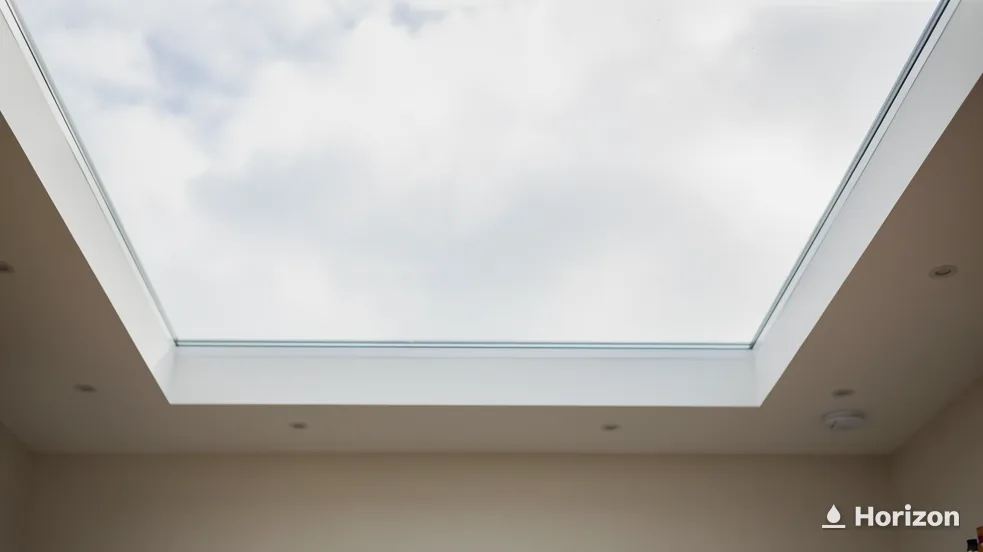
Ask whether the walk-on glass is laminated, which means layers bonded together in place of a single sheet. VELUX describes safety lamination on its roof windows as a laminated inner pane that stops broken glass dropping into the room after an accident. The same worry applies to a room below a terrace, so ask each maker what it says happens to the glass if a pane is damaged.
Glazing is the next choice. On the glazing, VELUX offers double or triple glazing across its curved and flat glass rooflights. Pane count affects warmth and weight together. A heavier build-up asks more of the frame and the kerb, which loops back to the rating.
Approved Document L (Wales) is guidance, and it sets 2.2 W/m²K as the figure a new or replacement rooflight in an existing home should meet. The document describes a rooflight as a glazed unit set out of plane with the roof, on a kerb or upstand. Which figure applies to your unit is settled at survey, once we have seen how it will sit in the roof.
The room beneath deserves its own thought. Warm, damp air from a kitchen or a shower meets the coolest surface in the room, and the underside of the glass can be that surface. An extractor and a window that opens elsewhere in the room can help keep the condensation in check.
Terraces, edges and the paperwork
Planning is the first paperwork question, because a roof people walk on can become a roof terrace. The Welsh Government says planning permission is required if a roof light would result in the provision of a roof terrace, and the permitted development rule for roof alterations leaves out terraces, balconies and raised platforms. The gov.wales page on roofs sets this out.
A terrace brings an edge, and an edge raises a separate matter from the glass. Approved Document K (Wales) covers guarding and falls, for example a drop of more than 600 mm in a dwelling, and the Welsh Government lists the full set of Approved Documents. Bring the edge into the conversation when you describe the terrace.
The location matters as well. In Wales a rooflight in a conservation area, inside the Gower AONB, in Bannau Brycheiniog National Park or in a World Heritage Site needs a planning application, and our skylight planning permission guide for Wales goes through the rest.
What we settle at the survey
The free survey is where your list meets the roof. You tell us what will stand on the glass, and we look at the structure, the falls of the terrace and the room below. The unit is chosen from what we find, and a fixed written quote follows once the survey is done.
We put 10 years on our workmanship, in writing. If you would like to talk it through first, ring us on 01792 929062 or send a message on WhatsApp.
Costs depend on the load rating, the size and the way the glass is supported, as covered in how much a walk-on rooflight costs. If you are weighing up whether glass is the right surface at all, can you walk on a skylight is the place to start, and the full range sits on our walk-on rooflights page.